


Governor Offers $200 for Slayer of Pauline Amsel
In an effort to arouse new interest in the apprehension of the slayer of Pauline Amsel, who was murdered in the home of her father, a prominent Jewish dry goods store merchant in Durant, about 6 months ago, Governor Robert L. Williams issued a proclamation of offering a reward on behalf of the State of $200 for the arrest and conviction of her assailant.
The girl’s father already has offered a reward of $1,000. A certified statement of which is on file in the office of the Secretary of state, bringing the total reward up to $1,200.
On the night of November 11, 1914 someone entered the room where the girl was sleeping and with a sharp instrument cut her throat from ear to ear. Aroused by her dying groans her parents entered the room just in time to see her assailant leaving through an open window. No statement could be obtained from the girl before she died almost instantly.
A diligent search was made for several days of Durant and surrounding territory, but not the slightest clue was developed as to the identity of the murderer. No motive was known for the tragedy.
Below is the complete story of the Amsel murder by Melody Amsel-Arieli.
https://amselbird.wordpress.com/tragedy-in-durant-oklahoma-manuscript/
Pauline Amsel Find-A-Grave
https://www.findagrave.com/memorial/67597646/pauline-amsel
Pauline Amsel’s killer has never been identified.
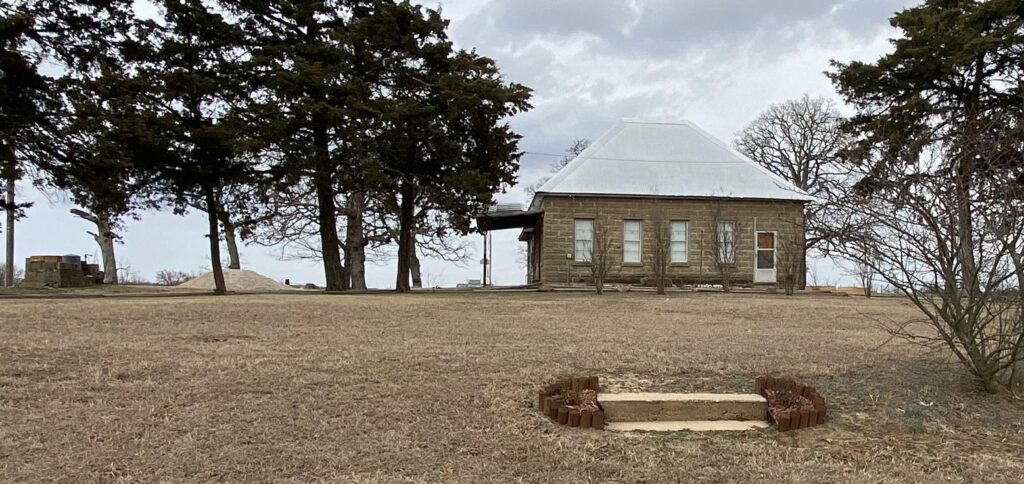
Below is the old Concrete School near Reagan, Oklahoma in Johnson County.
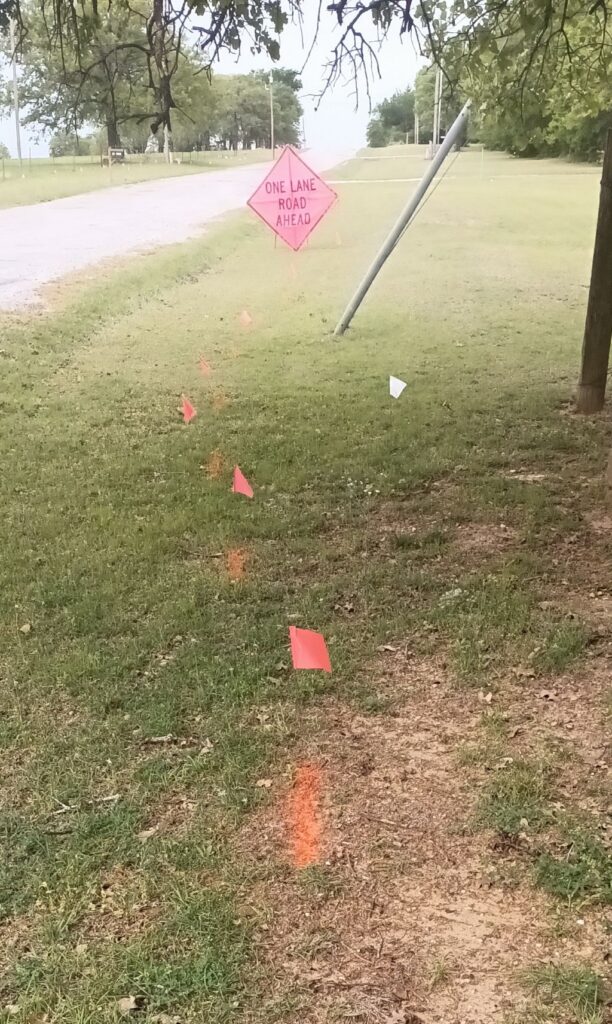
This week the fiber optics crew bringing high speed internet rounded the corner at Newport and Timber Road heading east on Timber.
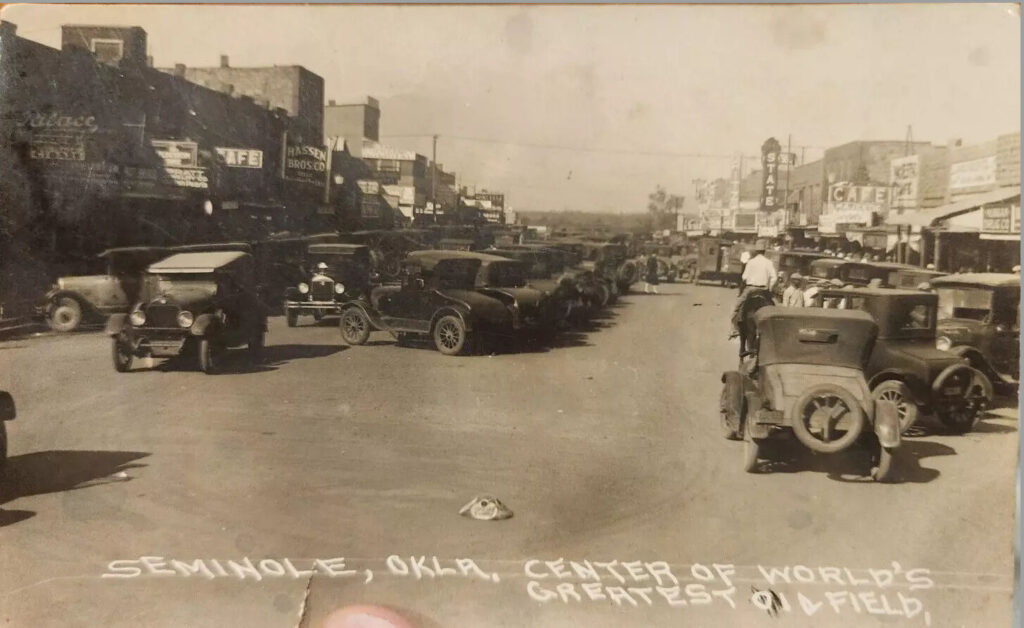
Seminole, Oklahoma oil boom days. 1920s
Mail from the Mailbag
Did you know that on July 16, 1935, the world’s first parking meter was installed in Oklahoma City. It was invented by Carlton C. Magee, lawyer, newspaper editor and, most importantly, inventor of the world’s first parking meter as a solution to parking congestion in downtown OKC. -Larry Paul
HAM Talk by Butch Bridges KC5JVT – Allstar node # 58735
The Arbuckle 97 Net conducts a check-in every Sunday night at 8:00pm. Any licensed HAM is welcome to check-in.
To all Amateur Radio operators: The next Arbuckle 97 Net breakfast will be April 26th @ 9am at Swadey’s BBQ in Ardmore, Oklahoma. This is not affiliated with any HAM club. Any licensed HAM is welcome to come and enjoy fellowship with other HAMs. Yes, Swadley’s does serve breakfast with 10 breakfast items on the menu!
https://swadleys.com/swadleys-bbq-menu/?rid=86


Below is from my newsletter archives dated
May 15, 2008 – Issue 590
I received an interesting call this week from Healdton, Oklahoma. The lady was inquiring if I had heard anything about a group of gypsies supposedly putting a curse on Healdton back around 1953 or 54. It seems every year about that time a group of gypsies would come into Healdton and stay a month or so working and doing odd jobs, etc. On this particular visit their “king” died in Healdton and for reasons unknown, the group put this curse on the town. The caller did not know if the king died naturally or maybe even killed. But whatever it was, it was a commonly repeated story among the citizens. The funeral was held at Collier Funeral Home and gypsies came from every part of the country to be there, camping out all on the grass and curbs in Healdton. Years ago gypsies (also known as Roma) were sometimes a misunderstood band of people. Anyway, this person that called me was wondering if anyone else remembers such a happening in Healdton in 1953 or 1954, and maybe who the ‘king’ was, and where he is buried. If anyone recalls this incident from the 50s taking place at Healdton, send me an email.
Last week we bought a coffee bean grinder, the burr type, as we wanted to grind our own coffee for use in the mornings. Not having any coffee beans, Jill traveled over to Wilson to our friends Susanne and Dan Jolliff at Coffee Professionals in Wilson and picked up a bag of Columbian coffee beans…. and the beans were a perfect roast! We can now make a rich deep coffee grind using our burr grinder for that early morning coffee, and when you grind it yourself, oh the flavor is all that much better.
https://oklahomahistory.net/ttphotos8a/CoffeeGrinder.jpg
https://oklahomahistory.net/ttphotos8a/BrewedCoffee.jpg


Ernest Martin came by last week and told me a story about he and his in-laws digging a water well back in 1939 south of Lone Grove. I thought it was such an interesting story I asked Ernest to type it up in an email to share with everyone, so here it is in his own words:
“The location of the old Heartsill farm is located south of Myall road and borders on the west by Meridian road. Edwin Taliaferro bought the property many years ago from Dewitt Heartsill when Dewitt went out of the dairy business. Dewitt was my Brother-in-law and through the seasons I lived with Dewitt & my sister while I was finishing my high school classes at Ardmore High School. Since I worked on the old farm in my spare time the place became much like my second home and I became acquainted with the kids at Lone Grove. The old Heartsill house & barn are now gone and there have been many houses added to the land that completely changes the very appearance of the property. Ed Taliaferro is like me, he is not young anymore but I visited with his wife by phone and she gave me an update on the old well which is still there and is being used for limited irrigation. They are using Lone Grove water. The old well still furnishes water but she tells me that it very hard. Dan Heartsill & I scratched off o circle & started digging. The ground was almost like sand stone and we used a sharpened buggy axel to make a place to set off charges of dynamite. We rigged up a windless with a bucket & rope to haul the shattered bits out to the surface. Although the ground was hard and the digging was slow we never gave up that we would encounter water. It took us about a year to strike water and although we were only 60 feet deep when we hit water it was a good supply of water. Later Dewitt contacted a Mr. Berry that had a well drilling rig and he dug down further before we walled the old hole with concrete. Since we had no electricity Dewitt bought an old one-lung gasoline engine at the sale barn and mounted it on the concrete cover and put over the well with the pump jack in place. We needed a method to transfer water to the barn & the house so we fixed a platform up in the twin trees that were close by. The platform was 2 vinegar barrels stubbed together with a 1 inch pipe so that the amount of water in the barrels would work for a water tower. We plowed a ditch down where where ever we needed to go and it worked for the time being. Through the years before, the only water we had was captured in a cistern which usually had wiggle tails included. This cistern was located mostly under the old house and a pitcher pump was used to use in the kitchen. Mrs Taliaferro told me that sometime later they had another well drilled but it was not very productive for home use. The old well is still producing water (hard) but thery are now using Lone Grove water in their home.” –Ernest Martin
Another subject Ernest Martin told me later, that I found very interesting I must share. I am sure few people remember this remedy for water well problems from hard water, rust, etc. Ernest had a stopped up water well problem this Spring and….. well, Ernest can tell it better than I can:
“Butch: When we came out here on this old hill in the Springdale area ,we had no grass or trees – and certainly no water. We hauled water to mix our concrete & mortar with. That was around 1953. We needed water so I contacted my friend “Harold Epperson” and he used an old Ft Worth spudder to do the drilling. The resulting well turned out to be approximately 150 Ft. deep but produced a good quality of water in great supply. I think this was in the days when PVC was not yet available so Harold got some used oilfield casing to use for well pipe. This resulted in pretty rusty/oily water but we keep pumping it out until it was usable for domestic purposes. Through the years we found that by pouring a box or two of Calgon into the well that we could keep down the formation of rust. Calgon is a (commercial) water softener and can be safely used. After several years Ardmore ran a water line out this far so we tied on to city water but we still used the well for irrigation of our garden and other plants. Trouble came about when we did not use the well last winter and the rust accumulated to the degree that our well stopped up with rust and silt. I was afraid that the well had caved in but I thought maybe if I could get some dry ice or even a good water softener down in the well that it may unstop the clog. I found the Calgon in town at Farmers Markert on Mill Street & poured the material into a gallon jug followed with enough water to make a strong solution. After figuring out how to get the solution into the well I gave it some time and then turned the faucet on to permit a small stream. As the stream became larger the old well recovered and is back to normal.” -Ernest Martin
“Here are some photos I took recently of a tree that’s growing out of the engine compartment of an old car in Springer (also an old cattle chute nearby). If you turn off of Hwy 77 and head west toward Gravity Hill (also called Magnetic Hill) (where you can roll uphill) this car is on the left hand side about halfway down.” -Rob Carter
https://oklahomahistory.net/ttphotos8a/GravityHill08a.jpg

https://oklahomahistory.net/ttphotos8a/GravityHill08b.jpg

https://oklahomahistory.net/ttphotos8a/OldCattleChute08c.jpg

Donald Bridges from California wrote you about his recollections of the mill that was used years ago for paying sales taxes. He thinks that the mill was worth 1/100th of a cent. Actually, it was worth 1/10 of a cent. I can remember it being used in the early 40s by the five and dime stores in Ardmore, one of which was Kress’s. Those stores had lots of small sales and apparently found it necessary to use mills in order to be able, in a practical way, to collect sales taxes on small sales. I believe the sales tax might’ve been around two per cent at that time. If a customer bought something for ten cents, the store couldn’t charge that customer a penny on that ten-cent purchase because it would’ve resulted in the store levying a 20 per cent sales tax. Neither was it practical for the store to forego the sales tax on small sales because the store would end up having to pay the tax on many of its sales itself. Therefore, when one made, say, a ten-cent purchase, he was required to pay two mills in taxes. As a kid I was never particularly happy about buying something for a dime and having to shell out eleven cents and receiving eight mills in change, but today I can certainly see the rationale.
The mills, as I recall, were fairly close to the diameter of a nickel and had a hole in the middle. I believe they were made of aluminum–not sure about that though.
At least one of the five and dime stores in Ardmore had a rather unique way of making change. It had only one cashier who made change, and that cashier was located upstairs in the back of the store. I believe there were several stations around the store that a clerk could go to to complete a transaction. When a purchase was made, the clerk would write up a ticket, put the payment and the ticket in a small tube, and then pull sharply on a cord to send the tube on its way to the cashier. Pulling the cord resulted in the tube attaching itself to a small belt that was constantly in motion running to and from the cashier. The belt was pulled and guided by a series of small pulleys about two inches in diameter. The tube would first go straight up and then make a series of 90-degree turns in order to end up at the cashier. The cashier would take the ticket and money from the tube, put the proper change in the tube, and send it back on its way to the clerk. As one can imagine, there was much whirring and clattering as the tubes went back and forth. As a kid, I was absolutely fascinated by the process, and would spend much time in the store watching this mechanical wonder at work. This is the only place where I’ve seen such a system and, even though I’ve told many people about it over the years, have never run across anyone who’d ever seen a similar operation. Today many banks, in their drive-through operations, use pneumatic tubes to serve the same purpose.” -Charles Walker, Fort Lauderdale, Florida
“In reading prior issues of “This and That” I see that there have been several requests for pictures of the old O’Savior School in Love County; also for the location of the school. Several people seem to have responded with general descriptions of location, including my friends Edgar Wallace and Mrs. Mary Wilson, also an unidentified person who told about growing up on a 1,000-acre ranch south of Post Oak. I’m pleased to be able to provide maps that will show the exact location of the school; also a picture of the school building and a couple showing school students.
The official name for the O’Savior School was the Simon Valley School as is shown on the document setting forth the formation of the school district, dated December, 1907. This district was one of the original school districts established in Love County after statehood. The school building was built on land allotted to and owned by Frank O’Savior, a Chickasaw Indian. It was located 4-1/8 miles east of Orr and 3-1/2 miles west of Simon in Section 13 (3/8 of a mile west of the southeast corner), Township 6 South, Range 3 West, of the Indian Base and Meridian. It probably was commonly called the O’Savior School because it was located on Frank O’Savior’s land, and to distinguish it from a prior “subscription” school called the Simon Valley School that was located on Simon Creek approximately 2 miles northeast of the O’Savior land. The location on Simon Creek was probably on what was commonly called the Alexander Farm, a large property that was divided into a number of separate parcels, each farmed by a different tenant farmer. The “Alexander Farm” is with little doubt the same property referred to above as a 1,000-acre ranch.
In the 1916 O’Savior School picture is a little girl by the name of Emma McMillan. Emma now lives in Wilson and recently celebrated her 100th birthday. I’m attaching a newspaper ad about the event that was sent to me by Mary Wilson. Emma, when she was 96, identified every person shown in the 1916 picture.
Someone wrote you whose father was R. O. Stubbs who, it was said, taught at O’Savior 1915-1917. Information that I have is that Stubbs taught at Orr in 1915-16. It will be noted that there were several Stubbs children in the 1916 O’Savior picture, whose parents were Edward and Florence Stubbs. The Stubbs family lived on a farm about 1 mile east of the O’Savior School; also had a store at that location. One of the Stubbs descendents had a store on Main Street in Ardmore for many years.
I would be very interested in communicating with the Stubbs descendent who communicated with you. Hopefully this person will read this and contact me.” -Charles Walker, Fort Lauderdale, Florida
https://oklahomahistory.net/ttphotos8a/OSaviorSchoolAround1910.jpg

https://oklahomahistory.net/ttphotos8a/OSaviorChapelSchool1910.jpg

https://oklahomahistory.net/ttphotos8a/OSaviorSchool1916.jpg

https://oklahomahistory.net/ttphotos8a/O’SaviorSchoolDistrict1.jpg

https://oklahomahistory.net/ttphotos8a/O’SaviorSchoolDistrict2.jpg

https://oklahomahistory.net/ttphotos8a/EmmaLoving100thBirthday2008.jpg

The Legend of Lonz Pennington – Kentucky fugitive makes his mark in Johnston county history.
https://oklahomahistory.net/ttphotos8a/LonzPennington.pdf
My records show that another Ardmore student died in The Great War, James Edward Duston, Jr. I noted “Inscription on tombstone (memorial). Co. B 141 Inf 36 Div, Killed in action near Etienne, France. Buried in France. In Greater Southwest Museum of History in Ardmore, there is a section of four square memorial tombstones, one each for the four members of Ardmore Highschool who were killed in World War I.” In an undated clipping in family records is the following – THE LATE PRIVATE DUSTON IS AWARDED THE CROIX DE GUERRE WITH PALM – The French War Cross posthumously awarded Private James E. Duston, who was killed in action Oct. 8, Has been received by his father. The decoration of the Croix de Guerre bore the palm, signifying an additional honor. Accompanying the decoration was the following letter, signed by Petain Marshall of France: “With the appreciation of the Commander in Chief of the American Expeditionary Force, the Marshall of France Commander in Chief of the American Expeditionary Force, the Marshall of France, Commander in Chief of the French Armies of the East, cites in the Order of the Army. First Class Private James E. Duston Company E, 141 Regiment Infantry, ‘A remarkably brave soldier. During the operation of October 8, 1918, near St. Etienne, he advanced over a terrain swept by a violent bombardment. By his courage he largely contributed towards neutralizing the fire of enemy machine guns and destroying their emplacements. Killed during action.’ ” I believe this to be from The Daily Ardmoreite. I will send by mail some other articles and pictures. Duston is also listed on the WWI memorial in Rose Hill Cemetery. Ardmore has certainly remembered him and his service ! Good luck in your new location and keep the news coming.” -Barb Hunt
“Haven’t written you in a while Butch. I always think of your cousin Roberta “Bobbie” Carmon Tilley, when I read your newsletter. The photo of Berwyn, I have 3 cousins in that one. 2nd row setting 6 from left is Narshalla Day. Next row directly behind her, Lynn Day. 2nd row standing from right #4 is Nelda Day. That was a very long time ago. Still reading at 75.” -Jo Evelyn Barton
https://oklahomahistory.net/ttphotos8a/1948-1949BerwynSchool.jpg


Rain, rain, go away, come again another day.
This modern English language rhyme can be dated at least to the 17th century, when James Howell in his 1659 collection of proverbs noted “Raine, raine, goe to Spain: faire weather come againe”.
Butch and Jill Bridges
Ardmore Oklahoma
580-490-6823
https://oklahomahistory.net