
Hope everyone is enjoying the Fourth of July holidays, even if it HOT outside. Back when I was a wee kid, like maybe 10 or 12 I had some firecrackers to pop. I guess my mother didn’t like the idea so she took them away from me and hide them in a Chest of Drawers in her bedroom. Years went by and about 1980 I found those firecrackers in a Zippy Pickles (Safeway Stores) jar I’ve had since the 70s. The jar contains some Black Cat firecrackers, one Red Rat firecracker, three green cherry bombs, two Auto Foolers, a box of Burglar Alarms, and some lady Fingers. Sometimes I’d get one out over the years and pop it. The past few years living in Lone Grove, like most towns and cities, it is against the law to pop fireworks inside the city limits. This year is different, as of 3 months ago the City of Lone Grove kicked me out of their city limits so I now live 300 feet into the county. So on the evening of July 4th I will pop three.

Back in the 80s I went to the Ardmore post office to check my mailbox. There was a man there, I guess you’d call him mentally challenged, came over to speak to me. He probably understood the true meaning of Independence Day, more than a lot of people do today. He stopped me that day in the post office, held up three fingers, and said, “I’m going to pop three firecrackers, one for me, one for God, and one for my country”. I’m planning to pop 3 of the Black Cats this year on the evening of the 4th in his memory.
Someone asked this week if there was ever a geodesic dome/home between Ardmore and Lake Murray? Yes there is. It’s still there, and located on Edgewood Road southeast of Ardmore. There was also one off Cisco Road, but it was torn down a few years back.

Some mail from this week’s MAILBAG…..
Q. Where did Bill and Barb’s restaurant start out on Highway 199 or Washington Street, several older people have said 199 any idea???
A. Back in the 1950’s, Bill & Barb’s Restaurant, was originally located on US 70 East (now called Highway 199 or Sam Noble Parkway) where the Comet Drive Inn is now, had a burger on the menu called the Whataburger. In the 1960’s when Gibson’s Discount Store was built on North Washington, Bill & Barb’s moved into the space at the north end of that strip mall.
HAM Talk By Butch Bridges KC5JVT – Allstar node # 58735 – Echolink # 101960
Our local Arbuckle 97 NET HAM radio group (it’s not a club) holds Check-Ins every Sunday evening at 8:00pm. Hope to hear some new HAMs check this Sunday (if you can hit the Repeater over the airwaves!


Below is from my newsletter archives dated
July 31, 2008 – Issue 601
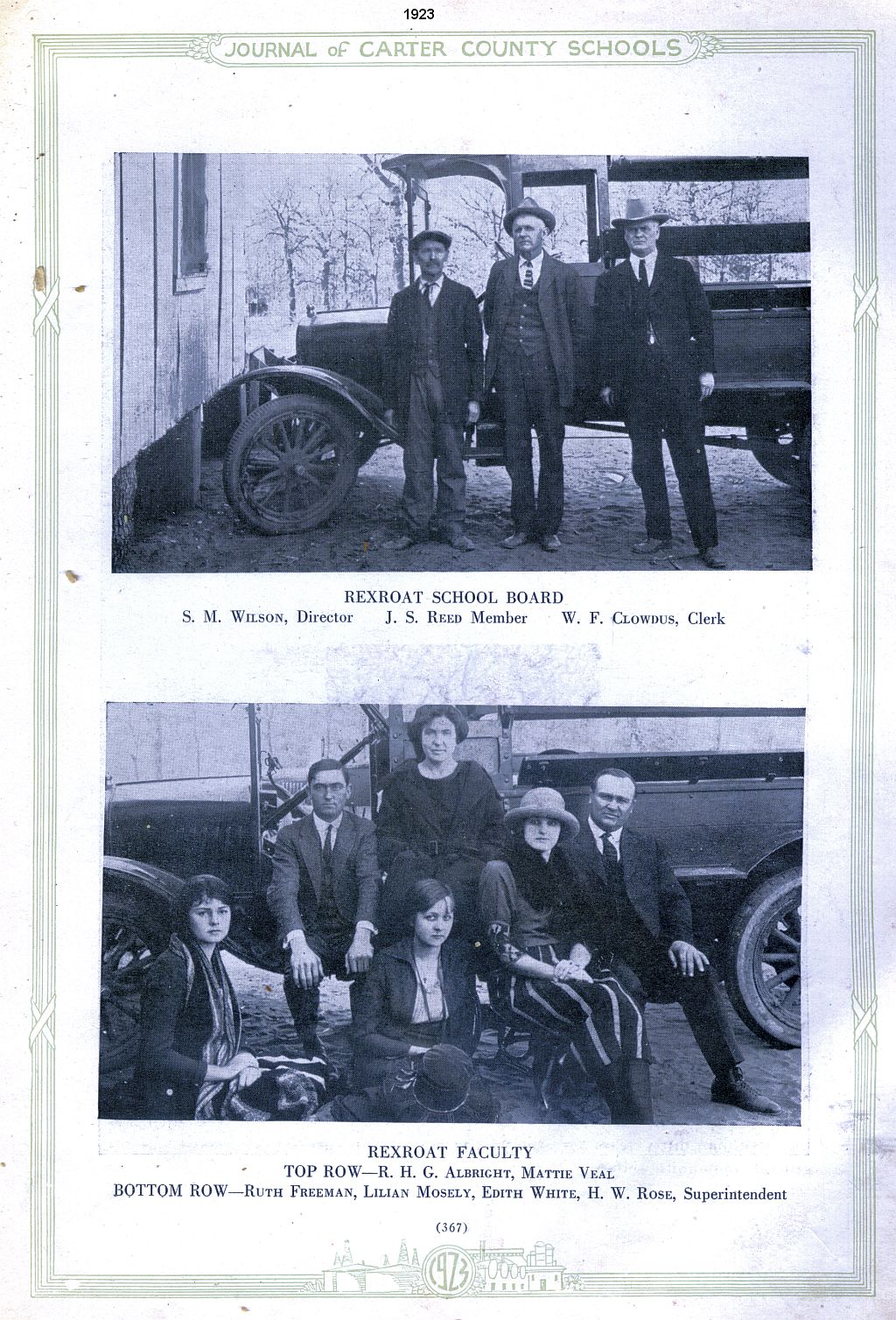
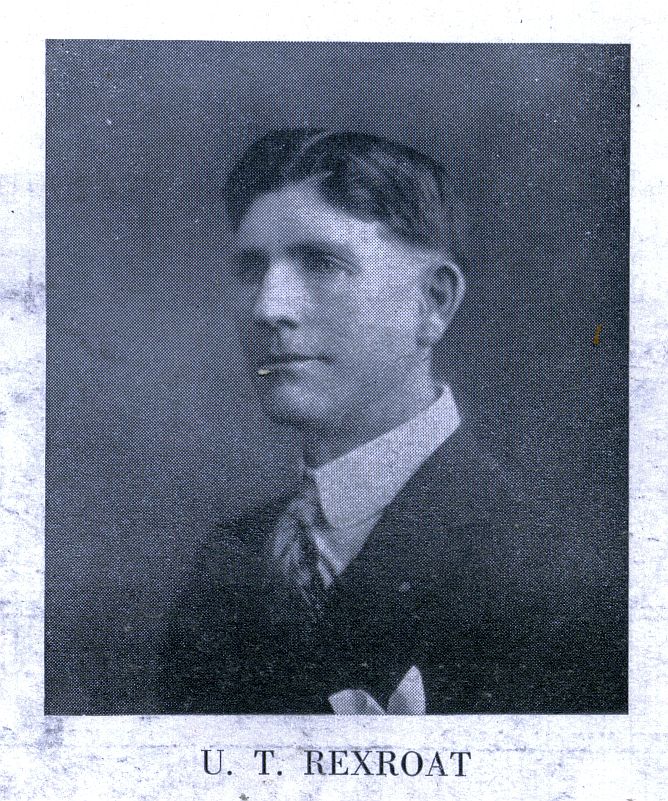
If you travel about 15 miles west of Ardmore on Highway 70, just before reaching the first Wilson turn-off, you come to Dillard Road. Turning north on Dillard road and going 1 mile you come to Dillard, Oklahoma. If you go 2 miles on north you will arrive at what used to be Rexroat, Oklahoma. There is nothing really left of Rexroat, but over 100 years ago it was a thriving community. We know that Rexroat was there about 1890, and really came to life during the oil boom years. The town is named after U.T. Rexroat, one of the first residents and teachers of that community, and later a state legislator. Not to many years ago some of his descendants stopped by to see me and we talked about U.T. Rexroat and how he saw that town grow from a few tents to a full fledged community, with stores and schools. I have scanned the Rexroat pages below from the 1923 Carter county school journal.
https://oklahomahistory.net/ttphotos8a/RexroatSchool1923a.jpg
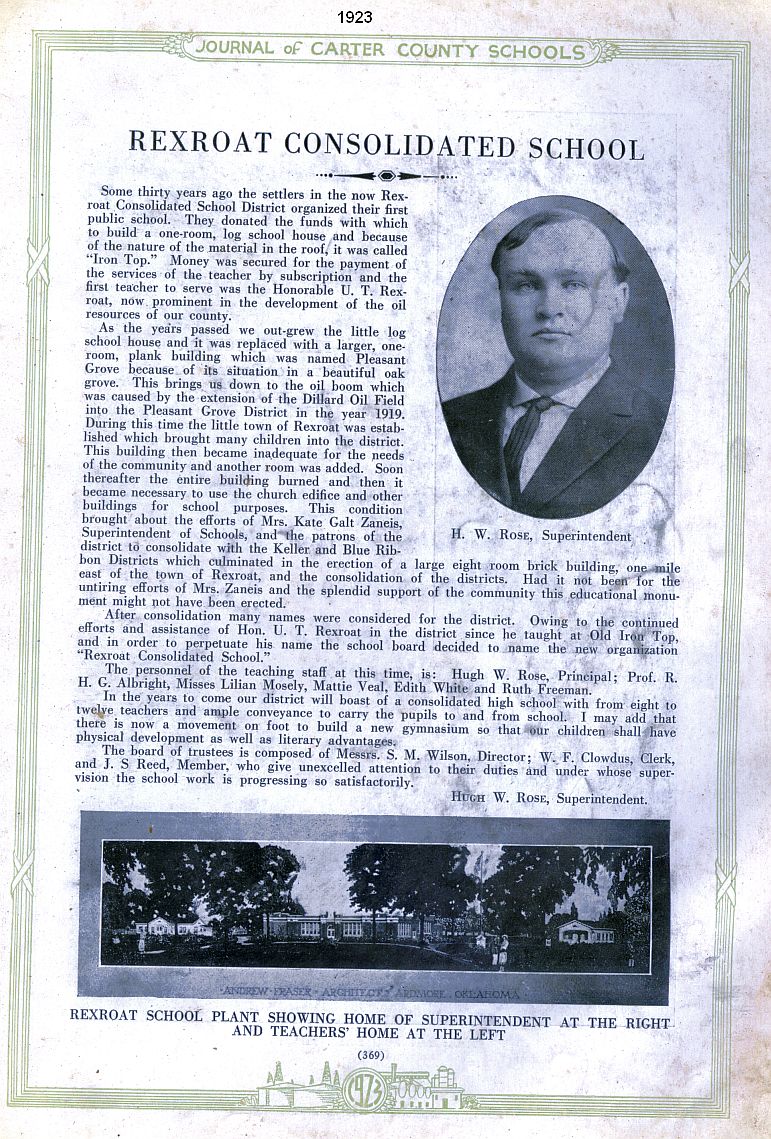
https://oklahomahistory.net/ttphotos8a/RexroatSchool1923b.jpg
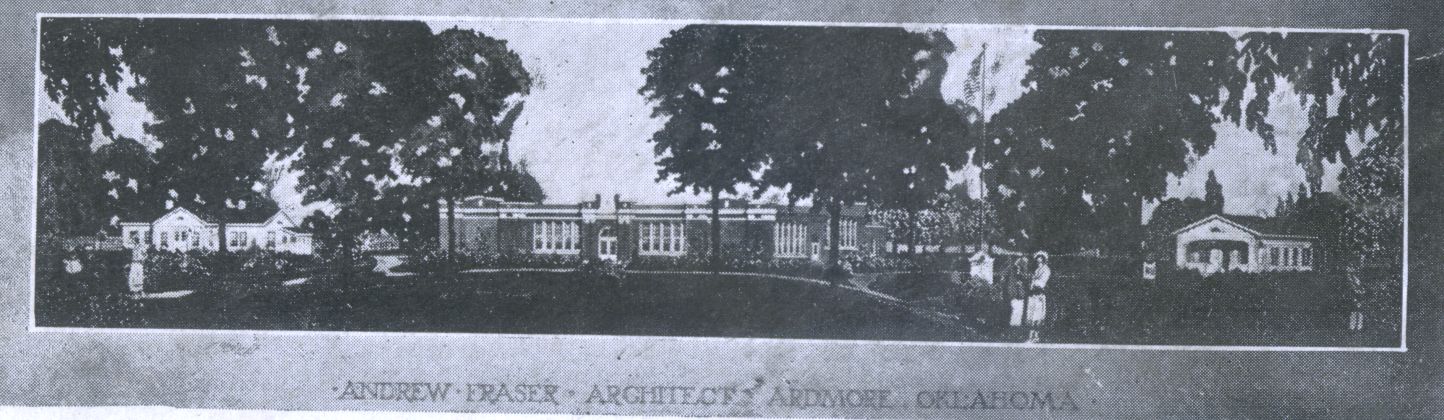
Board members of Rexroat school in 1923 were S.M. Wilson, W.F. Clowdus, and J.S. Reed. Superintendent was Hugh Rose. Faculty were H.G. Albright, Mattie Veal, Ruth Freeman, Lillian Mosely, and Edith White.
https://oklahomahistory.net/ttphotos8a/RexroatSchool1923c.jpg
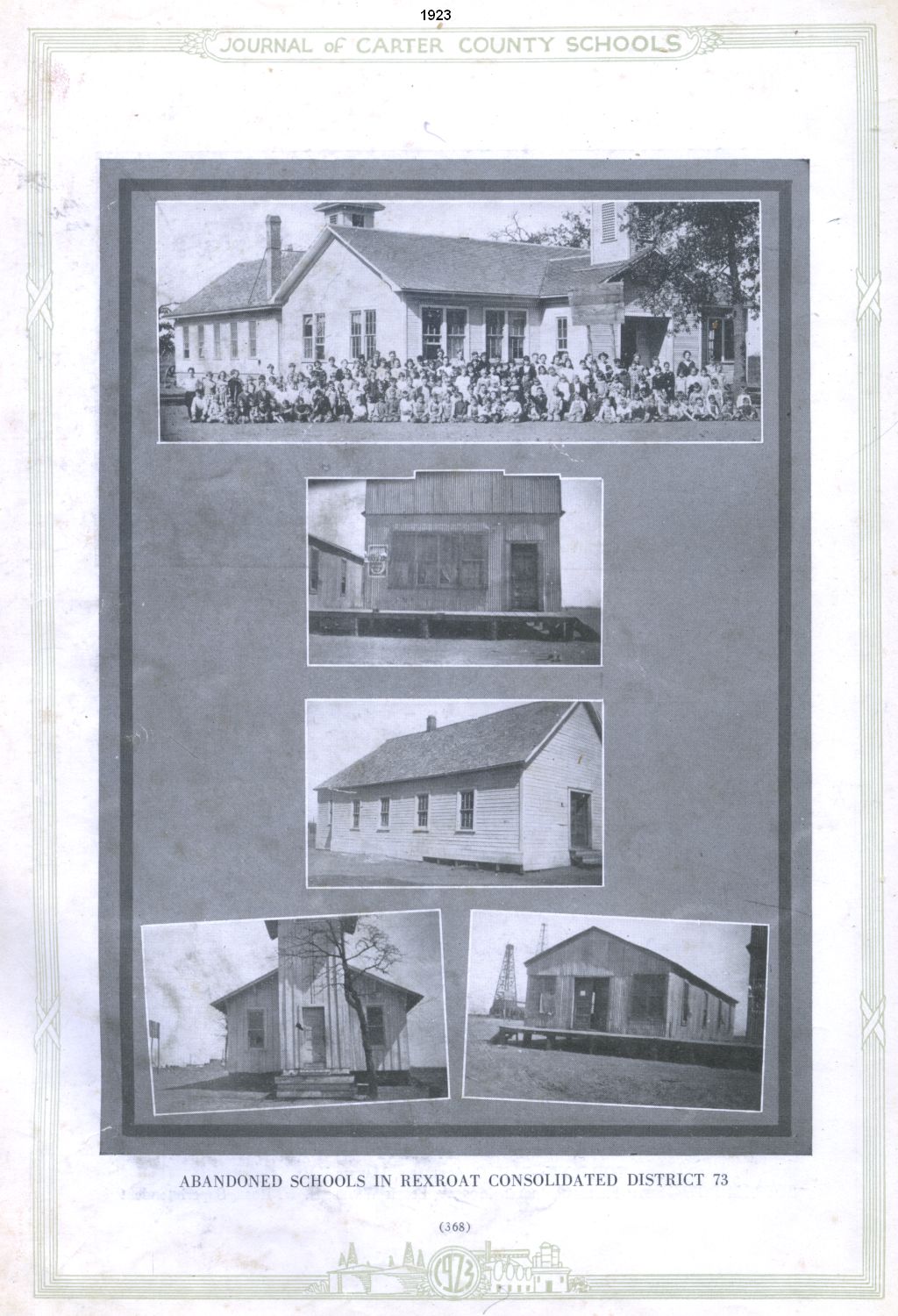
https://oklahomahistory.net/ttphotos8a/RexroatSchool1923d.jpg
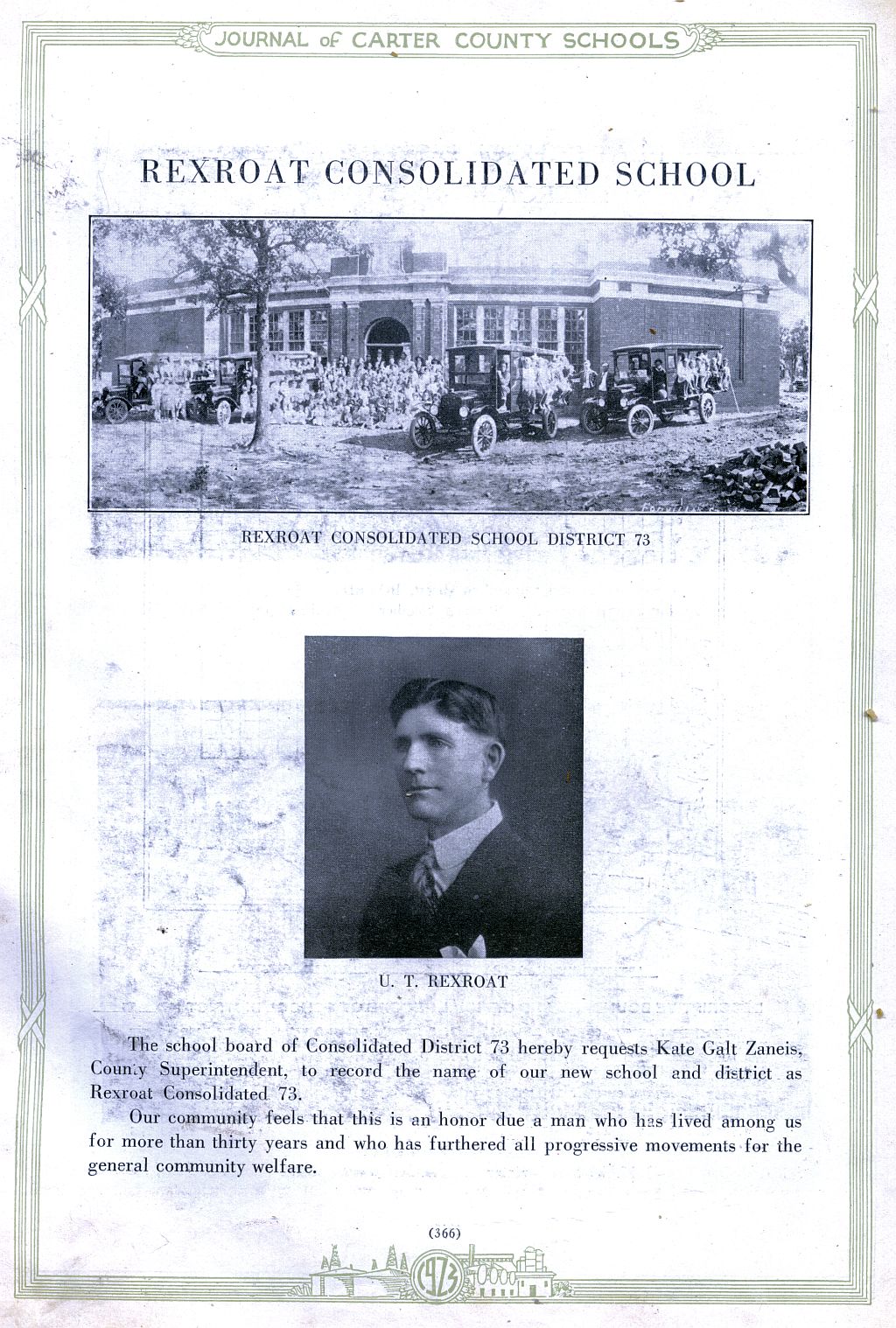
https://oklahomahistory.net/ttphotos8a/RexroatSchool1923e.jpg
https://oklahomahistory.net/ttphotos8a/UTRexroad1923.jpg
From time to time Mark Coe sends in some history of Ardmore’s bygone days, and this week he did just that. I always look forward to Mark’s emails because I never know what new piece of history he will share. Here is this weeks email:
During the Great Depression, the WPA conducted a series of oral history interviews in Oklahoma. The WPA began as the Works Progress Administration and later was called the Works Projects Administration. The interviews were compiled as the “Indian-Pioneer History Project of Oklahoma”. The following is from the interview with Alfred Owens in Sulphur on April 29, 1937.
“I was born July 28, 1863 in Georgia. I thought this was a better country than Georgia, so I moved to Sulphur in July 1889. I came with an uncle and a cousin in a covered wagon from Texas. It took four days to make the trip. We came by Durant, crossing the Red River at the mouth of Island Bayou. We forded the river at this place. After passing Durant, we came to Caddo. We crossed Blue River at Nail Crossing. We went through Twelve Mile Prairie and crossed the Washita River at Fort Washita. We then went to Mannsville, to Durwood, Provine, and thence to Ardmore.
“Ardmore had only one store at this time, run by Zuckerman. I well remember my first night in Ardmore. They were having a celebration in honor of the Santa Fe Railroad, which had not been built so long before this. [ Note: The first train arrived in Ardmore on July 28, 1887. ] We decided we liked this location. My uncle was looking for grass for his cattle, and this seemed to be the right spot, so we settled near here. I lived here for ten years.
“I began teaching a subscription school here. Each child paid three and a half cents per day to attend. We ran out of water and had to dismiss at the end of three months. The building was a log house about twenty feet long by sixteen feet wide. It had a board floor, and benches made of boards. We had a stove and used wood for fuel. We had a blackboard which I made out of one by twelve boards painted black. I made my own paint out of linseed oil and lamp black.”
July 28, 1887 The first train (Santa Fe Railroad) arrives in Ardmore. The town consists of a few tents, but the train brings lumber and other building supplies. Among the tents were two containing stores. One run by Sam Zuckerman and another by Frank & Bob Frensley. Not a single tree exists within the townsite west of the railroad tracks. Caddo Street becomes the first named street in town. So named because it was originally an old wagon road from the 700 Ranch house north to Caddo Creek.
The Daily Ardmoreite 12-03-1912
The rather unusual sight of an old union veteran and old confederate veteran being buried at the same time and in the same cemetery was witnessed at Rose Hill cemetery yesterday afternoon. Capt. T. B. Johnson, who fought with the federal side and Mike Gray who followed the cause of Lee were both laid to rest at almost the same hour.
The Daily Ardmoreite 12-17-1912
CONSTRUCTION WORK BEGINS
New Christian Church Structure Now Under Construction.
The contractor, B. H. Corlew, has begun the work of actual construction on the $15,000 Christian church building. The forms were all put in Monday and now the work of running the concrete into the foundation is well under way. The building, which is a new departure for this section, in architecture, will be of stone and brick. The stone, about seven carloads in all, will come from the famous Bromide quarries. Architect White who drew the plans for the building and who will act as supervising architect during its erection, stated today to an Ardmoreite reporter that the building would be pushed to an early completion as expeditiously as the weather conditions would permit.
“I remember the old Oakley Airport, had my first flight there with Art Oakley in his OX-5 TravelAire. Wiley Post lost his eye when a steel fragment struck him while working as a roustabout in the Healdton oil field. Art taught him to fly shortly after in a Jenny (a JN-4 surplus aircraft from WWI, lots of barnstormer pilots had them, and Art was a pioneer ) Another of Art?s students, Jack Cameron (family owned Cameron Refinery) acquired a plane, and would pick me up on Sunday afternoons and take me fly nag in his Cavalier. A lot of aviation notables came thru Ardmore in those years. When the wooden hangar burned it ended the airport. Several planes were lost, including Lloyd Noble?s cabin TravelAire, a large monoplane, Jack lost his Cavalier, among others. Art?s mechanic was heating the oil for the TravelAire in preparation for a trip, when it caught fire. Art had at that time been hired by Noble as his pilot, and flew for the company until he retired. They acquired the acreage at Springer for a municipal airport and built the large metal hangar with Art doing a lot of the work. John Heasty came to town with a beat up Piper Cub and took over as the operator, and as the war came on, obtained government contracts and operated a flight school, as well as being an aircraft dealer. Bob Goddard and I both obtained out private licenses in 1938 from Heasty, and after the war, Bob took over the operation and operated a flight school under the G.I. Bill, a charter operation and Cessna dealer. Later on an aerial spraying service. Ardmore had a lot of aviation history in the early days, sorry to get wound up, but you triggered old memories!” -Bill Johns
“Wiley Post lived in Ardmore while he took flying lessons. at the place of my early childhood home at 721 B NW. Don’t know how he lost an eye but the patch was a trade mark for him. Springer was the site of my first plane ride.” -Jim Renfro
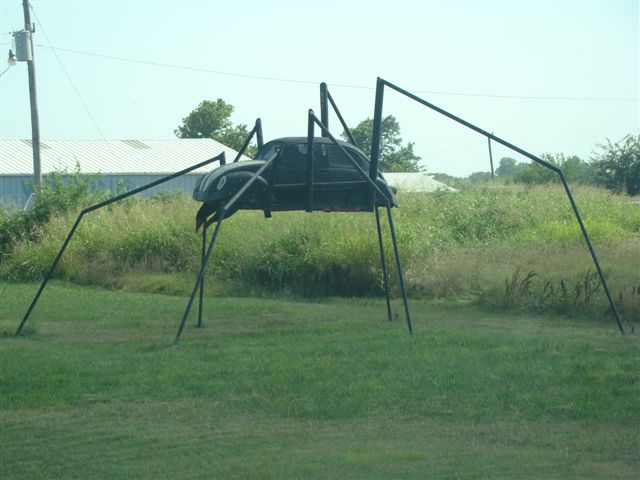
“This creature was constructed at Lexington Oklahoma, at a Body Shop.” -Rus Martin
https://oklahomahistory.net/ttphotos8a/LexingtonOklahomaSpider.jpg
“Moon flowers open in the evening so they can be pollinated by night-flying moths. Like most moth-pollinated flowers, the moon flower is white, which attracts moths. The moon flower is a close relative of the morning glory, which opens in the morning so it can be pollinated by bees and other insects that are active during the day. The moon flower petals die in the morning after they open. On a warm summer night, moon flowers can open in a matter of minutes. You like nature so much that I thought you might like to see our “moon flower” that bloomed this week.” -Sylvia Moore
“You will probably get many answers to your question about “how they measured miles” back in the early days. What they did was to make a mark on a wagon wheel and count how many times the mark would ‘come up’ in an already measured mile, and then they would again count how many marks would come up during their travels. It was very accurate and one of my (Warner) ancestors used that method to measure the Pennsylvania Turnpike (before they had automobiles) because the turnpike went through his land and one of the agreements that he signed was that he would have (and maintain) a toll-booth on his land, and collect the toll as folks entered the ‘pike” at that point!” -Roy K.
As a youngster I swam a good many times in Cache Creek in order to cool off. The creek ran through my Aunt and Uncle’s farm ( Bill and Ona McDonald). The farm was located south of Elgin and north of Lawton; the highway department took a lot of their property when Interstate 44 was built. My cousins and I had a great scare one evening as we were leaving the swimming hole. My eldest cousin was hurrying us to leave the creek – we thought he was just being mean. After we had climbed the bank on the west side he had us look back toward the creek. There, on an overhanging limb, lay a cougar, known to us as a panther. We were a group of scared kids !! There was a lot of wildlife along the creek; panthers, deer and squirrels. The deer would jump the fence enclosures at Ft. Sill and graze on the local farmer’s fields. They were forbidden to shoot the deer; but I know for a fact that venison graced many supper tables in those days.
My Grandfather’s brother, Jim Stamper, was killed while trying to cross Cache Creek where it ran just east of Ft. Sill – it was Thanksgiving Day and they were taking a load of hay to Lawton to sell. There was no bridge there, so they had to cross by going down into the creek bed and up the other side. As they were going down the load shifted, the horses spooked and the wagon was overturned, pinning him beneath it. He was pronounced dead at the scene.
Also, there was a skating rink called Lost Bridge, which was located on Cache Creek, east of Lawton. When I was in High School at St. Mary’s in Lawton it was owned by the Landoll family. I spent many happy hours skating there – it was closed in the winter time as it was not heated; had wooden windows that were raised and hooked to allow a breeze to flow through the rink. We could also swim there.
My Grandmother and Grandfather worked at the “County Farm” northeast from Lawton – Cache Creek ran through that property.
The story is that Cache, Oklahoma, located west of Lawton, was named for the close proximity to Cache Creek. Quanah was selected at first, but the Postal Service denied the request because of Quanah, Texas, which was about 100 miles away. Cache was selected as the second choice. Lawton and Cache have both expanded greatly in the intervening years, and the distance apart is not as great now.
There were times when Cache Creek would flood the nearby fields. Also the low-water crossings were impassable. My Mom said that when she and Dad first farmed just east of Mt. Scott and Lake Lawtonka, the road ran through the center of Ft. Sill, and then on to Apache. In fact, it was known as the Apache Road. (The highway department later built a state highway, that s presently Interstate 44 – it runs through Ft. Sill in the area of the “Old Corral”) There was a low-water crossing on Medicine Creek, and if there was a hard rain, people had to stay in Lawton until the water ran down. Or they could not travel to Lawton for the same reason.
Thanks for letting me tell some of my memories, Butch. Take care and God Bless. -Anna Marie Wilson, Lone Grove
I read where someone wanted to know the name of the town where the movie on Bass Reeves was filmed. The town is over at Reagan, Oklahoma. It is a movie set built by a guy named Johnny Shackleford. Johnny is one of the nicest fellows you will ever meet and his cousin cooks one of the best hamburgers you will ever put in your mouth at that movie set. The movie was named, The Black Marshall, the movie set is named, Sipokni West.”
The Wilson News by Mindy Taylor
11-03-1916
W. M. Wormington has decided that Wilson is a splendid place for a plumbing business and put in a complete line of plumbing supplies last week next door to News office. He will also handle sheet metal. Has been at the game for 25 years and suffice it to say assures satisfaction to all.
Sam Allard and W. T. McPherson will open up a line of 1917 styles in wall paper in the News building immediately. These boys have been in the business in some of the leading cities of Texas and Oklahoma and know it from the first principles up to the latest ideas in classy interior decorating.
L. H. Webb, contractor and carpenter, has located here. He is also prepared to do small jobs of wood work, painting, etc…
J. A. Conner has moved into a building near the News office and is now prepared to write you up a life insurance policy or real estate lease.
A Brand New Store: B. P. David & Son – General Merchandise – Look for the new brick store on Main Street, near W. B. Gill’s office.
City Barber Shop: E. J. Woods, Prop. – Located on North side near Mobley Corner. We appreciate your barber trade. Give us a trial.
Hudson Houston – Don’t forget we have plenty of Colorado and McAlester coal – Phone 32
Clowdus & Bridge – watchmakers, jewelers, expert watch repairing – All Work Guaranteed – Location: Crescent Drug Store
God Bless America, Happy Independence Day. We must always remember those who came before us and sacrificed so each of us can live in the greatest nation in the world. Independence Day is not just about fireworks and barbecues; it is a time to reflect on the freedoms we enjoy and the sacrifices made to secure them.
Please stay safe over the holidays.
See everyone next week!
Butch and Jill Bridges
Ardmore, Oklahoma
580-490-6823
https://oklahomahistory.net