
The Daily Ardmoreite
Ardmore, Oklahoma
Tuesday, September 19, 1917
Mr. and Mrs. R. C. Adams of Legate, Oklahoma, uncle and aunt of Miss Beulah Crabtree, who was killed at Pauls Valley last week, when she fell from a parachute, passed through Ardmore yesterday en route to Sherman, Texas where the body was taken for burial. Miss Crabtree is said to have lost her hold on the parachute and fallen 200 feet after she had made a balloon ascension at a carnival being held at Pauls Valley. She was considered one of the best aeronauts in this country. She was related to John T. Spears and V.C. Adams of Ardmore.
August 1963
Carter County’s 3 highway patrolmen, Leland Koch, Calvin Duncan, and Don Henley wound up their annual inspection of county school buses. Duncan said burned out stop lights caused most of the 15 buses to fail the test. The buses transport a total of 1,597 Lone Grove children daily. B. J. Potts of Lone Grove has been driving school buses for 22 years.
I wonder how many children are transported on Lone Grove school busses today?
August 1988
Roger Owens and his son, Scott, have opened a new shoe repair shop in Lone Grove, across from Bowlarama.
The only natural lakes in Oklahoma are a series of oxbow and playa lakes. The typically crescent-shaped oxbow lakes are found in abandoned channels (oxbows) of a meandering stream and occur mainly on flood plains of the major rivers, such as the Red, Arkansas, Washita, North Canadian, and Verdigris rivers in eastern and central Oklahoma. Oklahoma has many oxbow lakes, but sixty-two of them cover at least ten acres, and the largest, near the Red River in McCurtain County, is 272 acres.
Playa lakes form in shallow, saucer-like depressions scattered across the semiarid High Plains region of northwestern Oklahoma and the Panhandle. These water bodies are characterized by internal drainage and have no outflow. They hold water during and after rainy seasons, and most of the water is lost through evaporation and/or seepage into the ground. Only a few playa lakes last year-round, but the intermittent or ephemeral playa lakes number about six hundred and appear following thunderstorms.
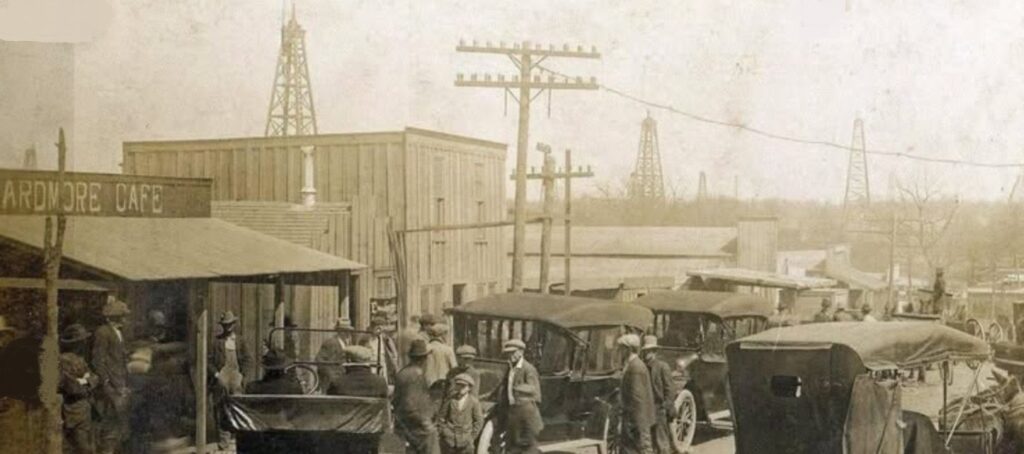
A view of downtown Healdton during the oil boom years. c.1915
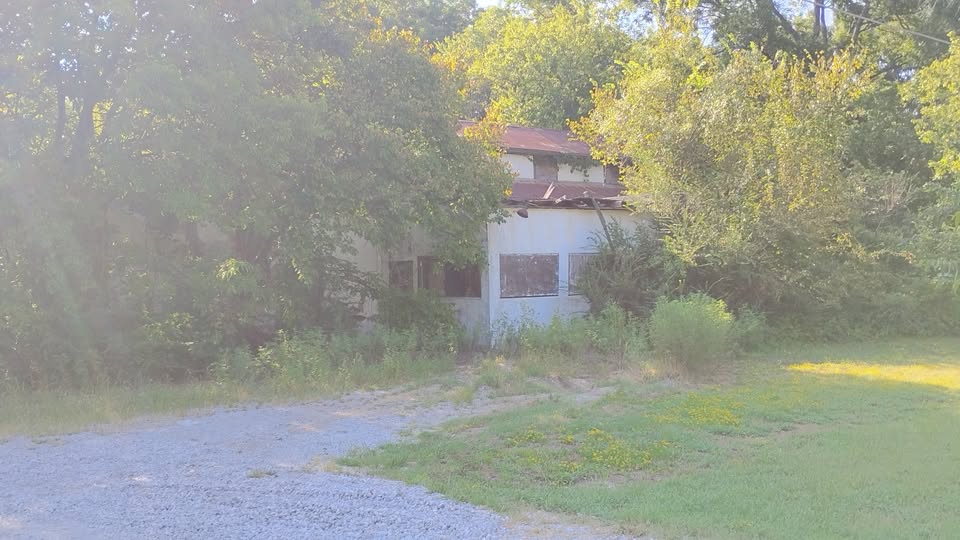
Below is what’s left of the old slaughter house at the end of K Street SE (south of the #2 Fire Station.
Some mail from this week’s MAILBAG…..
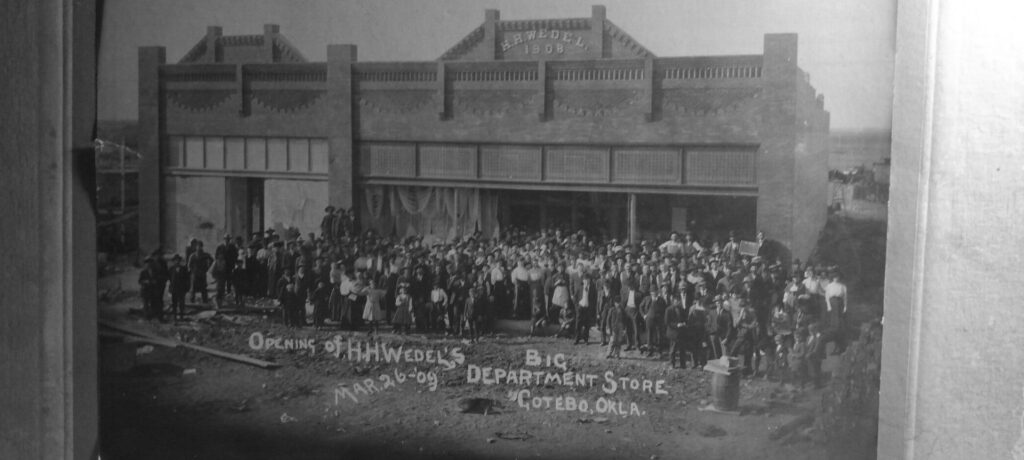
Formerly Harrison, in Northern Kiowa County, 6 miles west of Mountainview, Ok. Post office name changed to Gotebo February 25,1904. Named for the Chief of a minor band of Kiowa Indians. This is a 1908 photo of Wedel’s Department Store at Gotebo. -Robert Hensley
Butch, Your mention of the old Pratt’s grocery on Caddo brought back
memories of my employment there when I was a wee lad. I’ll never
forget the summer I spent behind the store painting by hand all the
grocery carts. I had to take off all the wheels, and clean the
bearings in gasoline. Then pack the bearings in grease. After all
this, I had to paint the carts silver with a paint brush. All this
done in the hot summer sun. Fun, fun, fun til daddy takes the T-bird
away.
Little did I know that this would prove good training in repetitive
tasks for my Navy flyboy days……
-Steve Miller (like the band)
HAM Talk By Butch Bridges KC5JVT – Allstar node # 58735 – Echolink # 101960
The local HAM group holds their weekly check-in every Sunday night at 8:00pm. Any license HAM is welcome to check-in.


Below is from my newsletter archives dated
September 18, 2008 – Issue 608
The Nelson Chigley Mystery
By Michael G. “Mickey” Shackelford
I have been working on researching some of the family history of my half brother, Joe Wyatt (Shackelford) Hollenbeck, who was a great grandson of Nelson Chigley, a full blood Chickasaw Indian. Mr. Chigley was born in Mississippi near Memphis, TN in 1834 or 1835 and came to Indian Territory sometime around 1860 and settled in the area that is now the City of Davis, Oklahoma. He married Julia Push-shu-ka (Indian for Thomas) in 1859, she died in 1909 and was buried at Green Hill Cemetery in Davis. They had at least two sons, Wyatt and Mose that were buried in Green Hill Cemetery in Davis. Mose Jr. died in 2001 and was probably the last direct descendent of Nelson with last name of Chigley and is also buried with his wife at Green Hill. Nelson and Julia also had at least two daughters that lived in the area as well. One of them, Agnes Suda (Chigley) Talley is buried just east of Davis in the Cunningtubby Cemetery. Hers is the only stone in the tiny cemetery that lies in the front yard of a home.
Now, trying to find out for sure that Nelson is buried at Green Hill Cemetery at Davis has been a little difficult since the burial records were lost in a fire years ago at the City of Davis and things like markers without names or dates are almost impossible to identify without relatives for verification as well as the completely unmarked graves in Green Hill. I read that Chickasaw Indians sometimes were buried with tall, flat, narrow stones that contained no markings at all. Nelson’s granddaughter, Garnet Pocahontas (Chigley) Shackelford (daughter of Wyatt) laid in an unmarked grave for many, many years until my father, Fay H. Shackelford (longtime Davis pharmacist) and my brother Joe finally got together and decided to place a marker there. Joe was buried next to that grave site just last month.
I recently talked to my mother Vye (King) Shackelford (Joe’s stepmother) who grew up in Davis and now lives on Chigley Street in view of the Mansion. She married my father after Joe’s mother passed away and spent some time at the Mansion before my father sold it. She says that she and my father spent weeks cleaning out every square inch of that place and there is no chance whatsoever that Nelson Chigley is buried in the house and doubts very seriously that he ever was buried under the house. Nelson’s death predates my father being married to his granddaughter Garnet, but my mother said my father was “spooked-out” about living in the same house that his father-in-law Wyatt had committed suicide in, much less living in a house where someone might be buried in or under. She said that my father would not even go into the room where Wyatt had shot himself in the head.
Maybe Nelson was buried on the grounds of the Mansion somewhere? My mother said that she had never heard any such story and had always assumed that he was buried at Green Hill Cemetery in Davis where all of the other Chigley’s that died in Davis had been buried including his wife Julia. She said that my father would have almost certainly known if Nelson was buried on the property and most likely would have mentioned it to someone. I visited the house many times over the years and never heard that story by my father or any of the several other people that we have known personally who lived in the house since my father. What a great story that would have made to tell my friends at school, who knew little if anything of the people or the history of the old building that stood on the North side of town for so many years before any of us were even born.
Nelson died on Nov 11, 1922. Although I have also read dates of 1927 and even 1929, but 1922 seems to be the consensus.
By the way, how exactly did Nelson Chigley die? Old age? Some disease? Garnet had cancer. I have also heard that Nelson committed suicide at the house and have also heard that Mose Sr. committed suicide in 1929 after the stock market crash at the Mansion. Who out there knows?
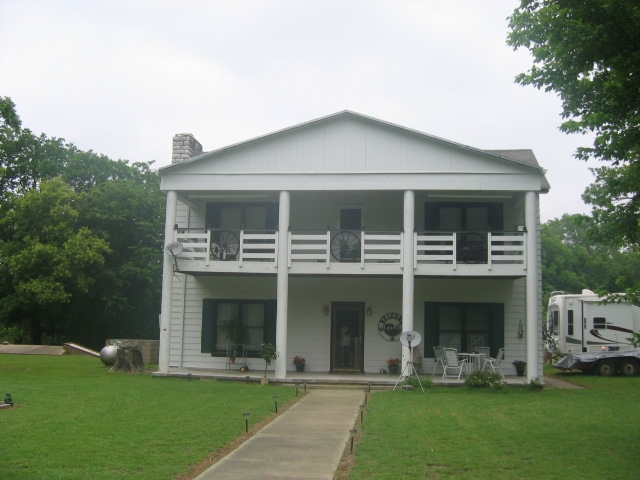
Present day Chigley Mansion in Davis, Oklahoma
“Nelson Chigley died about Nov. 16, 1922 in Davis, Ok. His funeral was in his son’s house in Davis. Burial place is not listed.”
https://oklahomahistory.net/ttphotos8a/ChigleyMansion.jpg
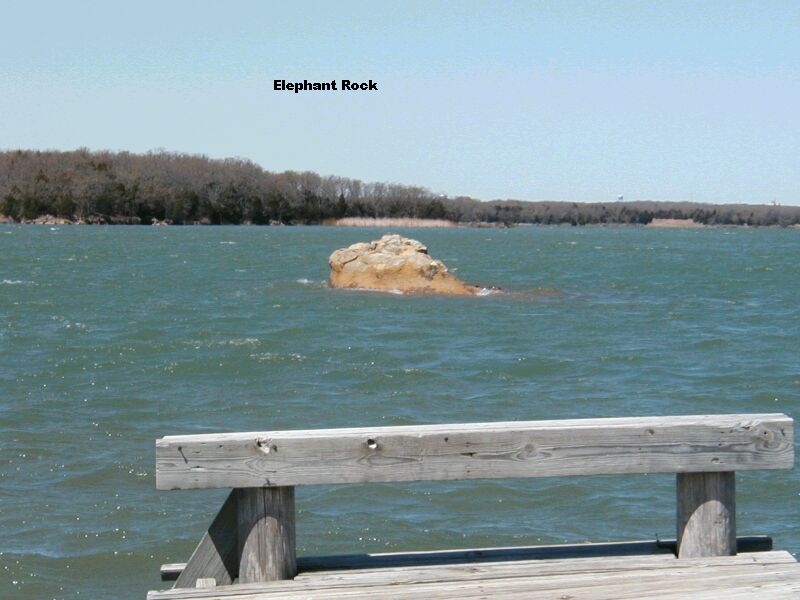
I was told this week that Elephant Rock was named by Jack Richards back when Lake Murray was built. Jack was working at Lake Murray at the time and when he was asked, he said it looks like an elephant. So, elephant rock it was.
https://oklahomahistory.net/lakemurray/elephantrock2.jpg
Ernest Martin out on Springdale Road stopped by to see me this week. I always learn something from Ernest, something from long ago, that most people either don’t know, or forgot about, every time he stops and chats. We were talking about our new water well (it’s doing great by the way) and he said the way they tested for hardness 50 or more years ago was using Tincture of Green Soap. You’d take a container and put 1 ounce of well water in it. Then let one drop of the Tincture of Green Soap drop into that ounce of water. Shake it. Keep dropping one drop at a time until it foamed up really well, and stayed foamed up. The droplet count determined your water hardness. The only problem in today’s world is finding Tincture of Green Soap according to Ernest. He didn’t know where a guy could buy it locally. I did a google search and find it still available by mailorder. But now that I think of about it, I would not be surprised if T&M Pharmacy at 12th and E Street NW carries the Tincture of Green Soap. They carry a lot of “old timey stuff”.
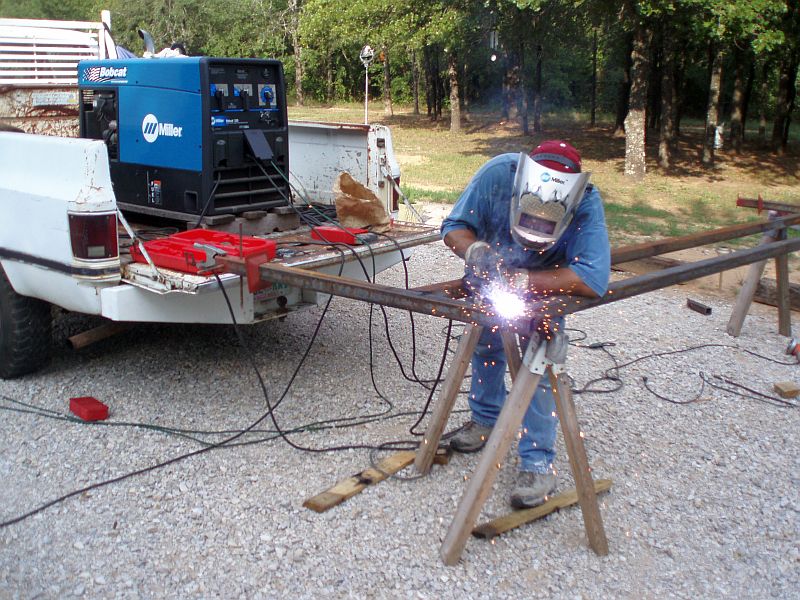
Since moving in to our new home south of Lone Grove the 2nd of last February, we have been needing a hand rail for the front entrance. Rick Westergaard left Ardmore for about a year and lived in Ohio where he worked for a large custom handrail manufacturing company by the name of Suburban Steel making handrails. After about a year there, Rick decided to move back to good old Ardmore and he eventually ended up working in the maintenance department at the Carter County courthouse. There was a need for a handrail behind the new County Clerks office about a month ago, so Rick having the experience in welding handrails was put to task. In about a day he had a beautiful and strong handrail. When I saw the quality of his workmanship, I asked Rick if he would build Jill and I a handrail for our home. He agreed and on a Saturday morning at 7am he set in to welding together the 1 1/2 inch square tubing. At the end of the day he had a set of professionally made handrails in place. If you could see his work in person, you’d know Rick was a true craftsman. His attention to every little detail, making a custom made, flawless, continuous hand rail from 4 pieces of square tubing, is evident in his work. Some might think Rick leans toward being a perfectionist. But that’s great with me, then I know his work is the best!
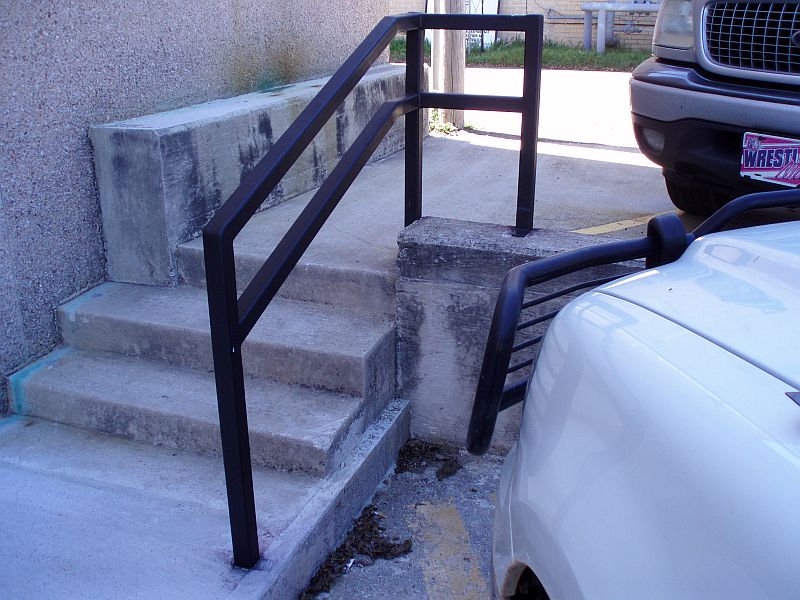
https://oklahomahistory.net/ttphotos8a/HandRailWelding.jpg
“The flag pole at the First Freewill Baptist Church on the hill west of town was placed there by my family in memory of my brother, Robert M. Adams. He was a Korean veteran having served with the 179th Tank Company, 45th Division. He was a Lt. Col. when he passed away in 2002. There is a plaque there at the foot of the flag pole.” -Mary Martin

Time waits for no one.
The earliest record of this phrase is dated 1225 before English was shaped in the modern form. The origin is uncertain, so it’s considered to be a proverbial wisdom. It means that no man has enough power to stop time or to change its course.
Butch and Jill Bridges
Ardmore, Oklahoma
580-490-6823
https://oklahomahistory.net